Everything About Jamaican Cigars (That Hardly Anyone Talks About Anymore)
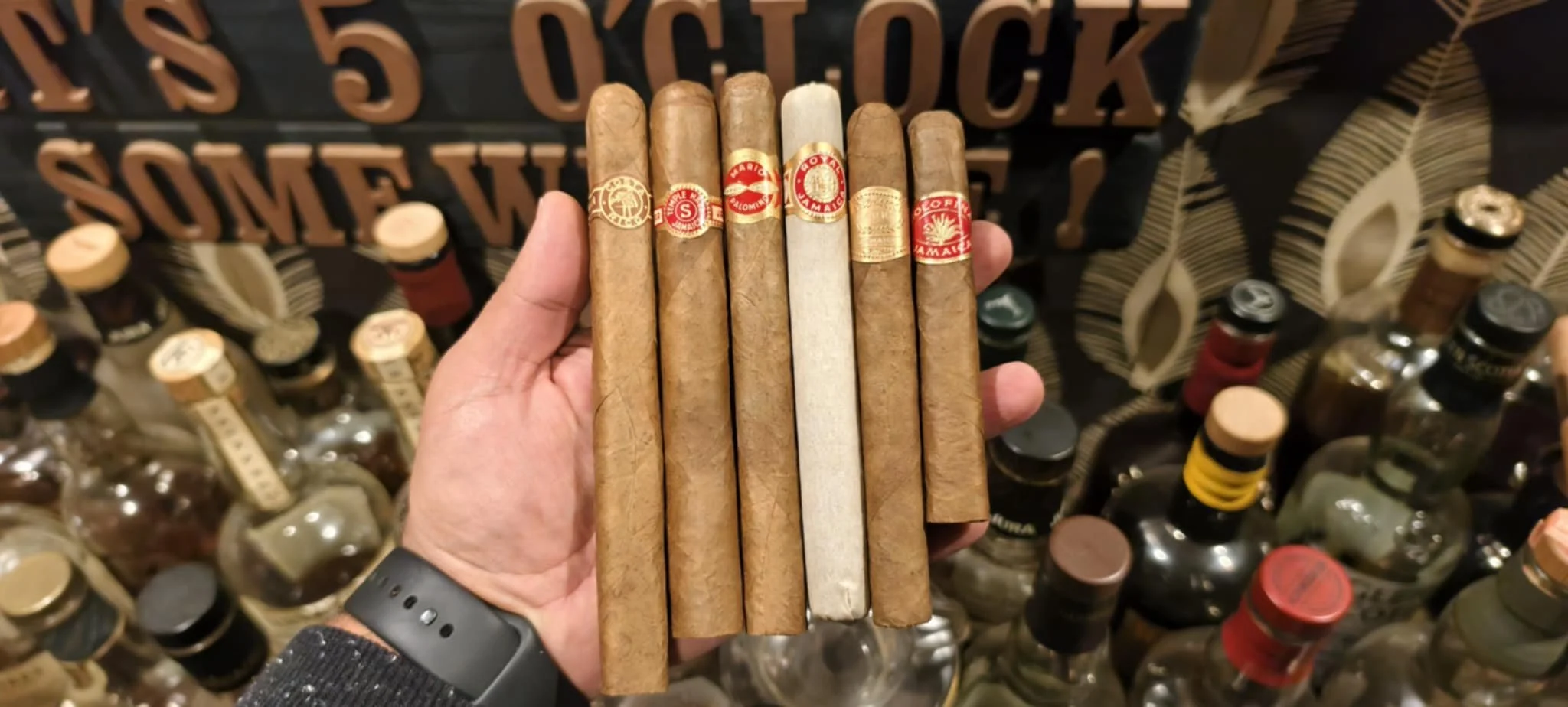
Jamaican cigars are one of those strange blind spots in the cigar world. Everyone knows Cuba, Nicaragua, the Dominican Republic, Honduras… and then there’s Jamaica, which quietly sits in the footnotes of history, despite the fact that at one point it was hugely important to British cigar smokers and even shaped the early identity of brands like Macanudo and Royal Jamaica. Today, actual Jamaican-made cigars are niche and limited, but the story behind them is too good to ignore: wartime economics, post-war Commonwealth politics, hurricanes, factory moves, and a handful of stubborn people still rolling cigars on the island because they believe the name “Jamaica” deserves to stay on a band.
I think of Jamaican cigars in three acts: the post-war rise, the storm-driven collapse, and the quiet little comeback. And somewhere in there, you’ve got Winston Churchill sneaking Jamaican cigars in private while the public still associated him with giant Cuban Churchills.
From Wartime Necessity to Post-War Style
The really interesting part of Jamaican cigar history doesn’t start with romantic plantations in the 1800s; it starts with cold economics around the Second World War. Britain was under enormous financial pressure and basically broke, and the government did not want to bleed precious hard currency buying cigars from outside the Commonwealth. Trade with Cuba was curtailed; money and attention shifted toward places inside the club. That’s where Jamaica came in. Several histories of Royal Jamaica and the wider industry make the same point: wartime currency controls and the need to keep spending inside the Commonwealth pushed the UK to develop cigar tobacco cultivation in Jamaica, which hadn’t traditionally been a big premium-cigar origin.
From there, the island built a reputation surprisingly fast. Jamaican leaf wasn’t as dense or powerful as Cuban, but it had a smooth, aromatic personality that fit perfectly with British tastes at the time: milder, civilized, “club room” cigars rather than nicotine sledgehammers. Brands like Royal Jamaica (founded in 1935 in Kingston) grew into serious players, especially after the Cuban Revolution and later the U.S. embargo pushed non-Cuban options into the spotlight.
Another giant born on the island was Macanudo. Before it became the mass-market Dominican juggernaut everyone knows today, Macanudo was a Jamaican-made, UK-facing brand produced at the Temple Hall factory in Kingston, using Jamaican tobacco as part of the blend. In 1969 General Cigar bought Temple Hall, and in the early 1970s they rebuilt Macanudo into the ultra-mild, Connecticut-wrapped cigar that eventually became the best-selling premium cigar in the U.S. Even when production later moved to the Dominican Republic, Jamaica remained the brand’s origin story; Macanudo itself still talks about starting “from a small Jamaican factory” before going global.
Now, about Churchill. The usual line in biographies and cigar pieces is that he was a Cuban man through and through: Romeo y Julieta, La Aroma de Cuba and other Havanas, often in large formats, and in ridiculous quantities. But there’s a bit of cigar-lore that fits neatly with the Jamaican story: in the lean years around and after WWII, when Britain was effectively skint and trying to keep currency inside the Commonwealth, a lot of British cigar money went to Jamaican production instead of Cuba. Some writers go as far as to suggest that when Churchill wasn’t performing in public with big Cuban bands, he leaned more than people realise on Jamaican cigars, partly out of habit from the wartime years and partly out of a sense that Commonwealth producers should be supported while the country was almost bankrupt. Hard proof is thinner than it is for his beloved Cubans, but given the wartime currency rules, the growth of Royal Jamaica and Temple Hall in exactly that period, and the way British smokers were encouraged to “buy Commonwealth,” the idea fits the bigger picture.
Either way, by the 1960s–1980s Jamaica had a real seat at the cigar table. You had Royal Jamaica and other island brands, Temple Hall turning out Jamaican Macanudos, and a reputation for cigars that were smooth, aromatic and genteel rather than ferocious. If you were a British smoker who wanted something milder than a full Cuban but with more character than a random machine-made, Jamaican cigars were very much “a thing.”
Hurricanes, Factory Moves, and a Vanishing Act
Then nature intervened. In September 1988 Hurricane Gilbert smashed into Jamaica and pretty much wrecked the island’s tobacco and cigar infrastructure. Contemporary reporting and later retrospectives all tell the same story: the storm devastated the budding premium tobacco sector; Royal Jamaica’s Kingston factory and farms were heavily damaged, and the brand never really recovered on the island.
Macanudo, which had already grown far beyond its Jamaican roots, followed a different path but ended in a similar place for the island. Through the 70s and 80s, it kept using Jamaican tobacco and Temple Hall as part of its identity. But as volumes exploded and quality demands shifted, production slowly migrated. By 2000, the Jamaican facility was closed and Macanudo was made entirely in the Dominican Republic, with Jamaican tobacco phased out of the main blends. Later limited releases paid tribute to the Jamaican origins, but the actual day-to-day cigars in humidors were no longer “Jamaican” in any agricultural sense.
Royal Jamaica as a band all but disappeared until a modern revival brought it back as a Casa de Montecristo exclusive—again, produced in the Dominican Republic, using non-Jamaican leaf but trading on the Kingston heritage and artwork. Cigar geeks on forums pointed out the irony: a brand literally called Royal Jamaica reborn as a Dominican cigar, with the original farms gone and the factory knocked out decades earlier.
The net result is that by the early 2000s, Jamaican cigars largely vanished from the mainstream. The big production brands and the largest export volumes shifted to the DR; the island’s tobacco cultivation never fully rebuilt after Gilbert; and for most smokers, “Jamaican cigar” became either a nostalgic memory or a novelty bundle on a discount site. For a country that had once been developed specifically so British smokers could keep their cigar money in the Commonwealth, it was a brutal fade-out.
Jamaican Cigars Today – Boutique Survivors and Why They Still Matter
The story doesn’t end there, though. Jamaica still has a small, stubborn premium-cigar scene, and if you care about history and character, it’s worth paying attention to what’s left.
The most visible name now is Barrington House Cigars out of Kingston. They position themselves deliberately as the Jamaican cigar house, using Jamaican tobacco in the filler, blended with Dominican and Mexican leaf, and wrapping it in Connecticut shade to keep the profile elegant. Their “Pride of Jamaica” and related lines are hand-rolled, slow-burning, and marketed as rich but smooth—very much in that traditional Jamaican style: more aromatic than aggressive, more cool smoke than brute force. You’re not getting massive production or endless line extensions; you’re getting an island boutique that wants “Jamaican cigar” to mean something again.
Alongside that you’ll still see Jamaican-made or Jamaican-branded cigars trickling into certain retailers and online shops—things like Jamaica Bay or smaller private labels tied back to Barrington’s production. They’re not trying to compete with Estelí or Santiago on volume; they’re speaking more to the smoker who wants to taste a different chapter of Caribbean history. Typically, these sticks sit in the mild-to-medium band, often with Connecticut or claro wrappers, light-to-medium body and flavours that lean creamy, woody, slightly herbal and sweet rather than dark and muscular. If you go in expecting a Nicaraguan powerhouse, you’ll be confused. If you go in expecting something closer to old-school British club cigars, they make a lot more sense.
The heritage is what really keeps Jamaican cigars interesting for me. This is a country whose cigar industry was basically engineered by wartime necessity, boosted by post-war Commonwealth politics, linked (at least in spirit) to Churchill’s behind-the-scenes smoking life, then hammered by a hurricane and hollowed out by factory moves. You can feel that whole arc when you line up a few key pieces: an old Royal Jamaica made with real island leaf; a 70s–80s era Macanudo from the Temple Hall days; a modern Barrington House cigar rolled in Kingston. Same flag on the box, three completely different eras in the mouth.
So when people talk about Jamaica now, it’s usually rum, beaches and reggae. Fair enough. But buried inside that story is a cigar history that helped shape how Britain smoked in the 20th century, gave birth to one of the biggest mild brands on the planet, and still survives in a couple of small rooms in Kingston where people are rolling “Born & Raised in Jamaica” cigars because they refuse to let that chapter close.
If you’re building a serious cigar journey, I think Jamaica deserves to be in there—not because it’s the strongest or the rarest, but because it reminds you that this culture isn’t just Cuba vs. Nicaragua vs. Dominican Republic. There are side roads and forgotten factories and little Commonwealth experiments that left a real mark on what we smoke today. Light up a Jamaican cigar with that in mind and suddenly it doesn’t feel like a novelty anymore. It feels like you’ve found a missing page in the book.